Skip to content
Sober Living Los Angeles
Comparison · Recovery Housing

Sober Living vs Halfway House vs Oxford House vs Rehab

Four different stages and styles of addiction recovery support, distinguished by clinical care, who runs them, how they are funded, and how long you stay.

Four-Way Comparison Cost & Length of Stay Which Fits You
Comparison of sober living, halfway house, Oxford House, and rehab
David Beasley, Founder and Recovery Advocate at Sober Living Los Angeles
Reviewed byDavid BeasleyFounder & Recovery Advocate
Published Jun 17, 2026Updated Jun 17, 202612 min read

This guide is educational and is reviewed for real-world recovery accuracy. It is not a substitute for personalized medical or clinical advice. Cost and length-of-stay ranges are typical estimates and vary by program and region.

Sober living homes, halfway houses, Oxford Houses, and rehab are four different stages and styles of addiction recovery support, distinguished mainly by whether they provide clinical treatment, who runs them, how they are funded, and how long you stay. A sober living home is a voluntary, non-clinical, peer-supported residence for people who have left rehab, which sets it apart from the medical treatment of rehab, the often court-connected structure of a halfway house, and the entirely resident-run model of an Oxford House.

This guide defines each option, compares them on cost and length of stay, explains which require finishing rehab first or being court-ordered, answers whether a sober living home is the same as a halfway house, and helps you decide which option fits your stage of recovery.

At a Glance

What Is the Difference Between Sober Living, Halfway Houses, Oxford Houses, and Rehab?

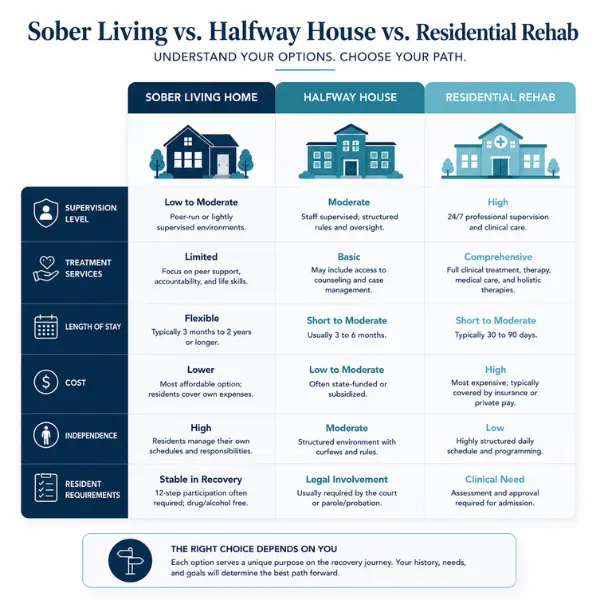
The difference between sober living, halfway houses, Oxford houses, and rehab comes down to four factors: clinical care, management, funding, and duration. Rehab provides medical treatment; the other three provide substance-free housing without clinical treatment, and they differ in who runs them and how residents qualify. The table below compares all four at a glance.

Dimension Rehab (inpatient) Sober Living Home Halfway House Oxford House
Clinical treatment on-site Yes No Sometimes No
Who runs it Licensed clinical staff Owner/operator + house manager Staff, often state or program funded Residents (democratic, self-run)
Voluntary or court-connected Voluntary Voluntary Often court- or corrections-connected Voluntary
Typical entry requirement Detox/medical need Sobriety + usually post-rehab Referral, court, or program 80% resident vote, sobriety
Typical cost $5,000–$20,000+ / 30 days $500–$2,500 / month Often free–$300 / month Shared rent (~$100–$200 / week)
Who pays Insurance / self-pay Usually self-pay Government / program / sliding scale Residents (self-supporting)
Typical length of stay 30–90 days 6–12 months A few months to a year No fixed limit
Governing body State licensing / CARF NARR / state certification State, federal, or program oversight Oxford House Inc. charter

Each option is explained in detail in the sections that follow, starting with the sober living home itself.

Sober Living

What Is a Sober Living Home?

A sober living home is a substance-free residence where people in recovery live together with shared rules, peer accountability, and a house manager, but without on-site clinical treatment. A sober living home is voluntary, and residents typically enter after completing rehab, using the home as a structured bridge between treatment and independent living.

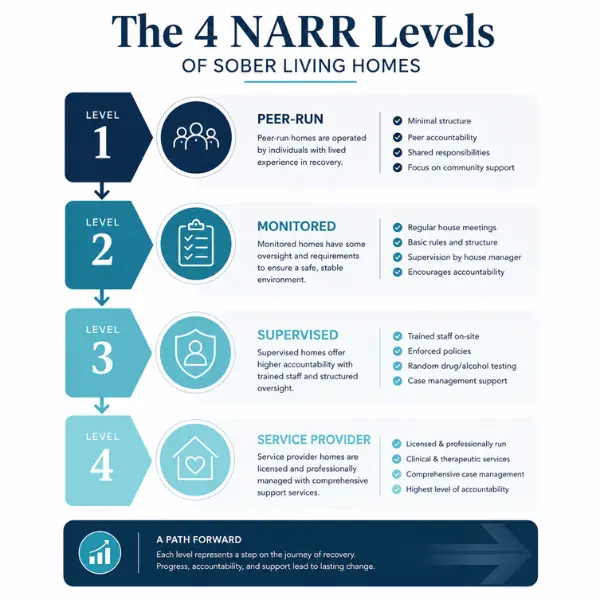
Sober living homes are commonly classified using the four levels defined by the National Alliance for Recovery Residences (NARR), ranging from peer-run homes (Level I) to homes with clinical services on-site (Level IV). Most sober living homes fall in the middle, offering a house manager, drug testing, curfews, and required recovery meetings while leaving residents free to work, attend school, and manage their own days.

What distinguishes a sober living home from the other options is its balance: more structure and accountability than an Oxford House, no clinical treatment like rehab, and no court connection like many halfway houses. This makes the sober living home the standard choice for someone who has finished treatment and wants support without losing independence.

Halfway House

What Is a Halfway House?

A halfway house is a transitional residence that is more regulated than a sober living home and is often connected to the criminal justice system or a funded treatment program. Halfway houses serve two overlapping populations: people completing addiction treatment and people transitioning out of incarceration, the latter formally known as residential reentry centers under the Federal Bureau of Prisons.

Because halfway houses are frequently government- or program-funded, they often cost little or nothing to the resident, but they also tend to impose more restrictions, including set time limits, mandatory programming, and stricter oversight. Stays are usually capped, lasting from a few months to a year, after which residents must move on regardless of their preference.

The key contrast with a sober living home is funding and entry. A halfway house may be assigned through a court, a parole condition, or a treatment program, whereas a sober living home is chosen voluntarily and paid for privately. This makes the halfway house less flexible but more accessible to those without the means to pay for a sober living home.

Oxford House

What Is an Oxford House?

An Oxford House is a self-run, democratically governed sober living residence with no paid staff, where residents share expenses and vote on house decisions. Founded as a model in 1975, Oxford House has grown into a network of more than 2,000 chartered houses, each operating under the same simple charter rather than under an owner or operator.

An Oxford House has three core requirements: residents must stay sober, pay an equal share of household expenses, and avoid disruptive behavior. New residents are admitted by an 80 percent vote of the existing members, and there is no fixed limit on how long someone can stay. Because there is no house manager or professional staff, accountability comes entirely from the peer group.

Compared with a sober living home, an Oxford House offers more autonomy and lower cost but less structure. There is no professional oversight, no formal program, and no required services beyond the three house rules. For someone who wants maximum independence and democratic peer support, an Oxford House fits; for someone who wants a house manager and structured programming, a sober living home is the closer match.

Not Sure Which Option Fits?

Our team can help you understand where a sober living home fits in your recovery and whether it is the right next step after treatment.

Rehab

What Is Rehab, and How Is It Different?

Rehab is intensive clinical treatment for addiction, delivered by licensed medical and counseling staff, and it is fundamentally different from the three housing options because it provides therapy and medical care rather than just a place to live. Rehab, also called residential or inpatient treatment, is usually the first step in recovery, while a sober living home, halfway house, or Oxford House comes afterward.

During rehab, residents receive medical detox if needed, individual and group therapy, psychiatric care, and a structured clinical program, typically over 30 to 90 days. The cost is correspondingly high, often paid through insurance, and the stay is short and treatment-focused. Rehab is where the clinical work of early recovery happens.

A sober living home is different because it provides no clinical treatment; it provides the stable, sober environment in which a person practices what they learned in rehab. This is why the two are complementary rather than competing: most people move from rehab into a sober living home, using treatment to stabilize and the sober living home to rebuild independent life.

Cost & Duration

How Do They Compare on Cost and Length of Stay?

On cost and length of stay, the four options range from short and expensive (rehab) to long and low-cost (Oxford House), with sober living homes in between. Rehab costs the most per day but lasts the shortest time, while housing options cost far less per month and support much longer stays.

Rehab typically costs $5,000 to $20,000 or more for a 30-day inpatient stay, usually covered partly by insurance. A sober living home generally ranges from $500 to $2,500 per month, with Los Angeles homes toward the higher end, and is usually paid privately; the full breakdown is covered in the guide to sober living cost in Los Angeles. Halfway houses, often funded by the state or a program, may cost from nothing to a few hundred dollars per month, while an Oxford House asks residents to split actual household expenses, commonly around $100 to $200 per week.

Length of stay follows the opposite pattern. Rehab lasts 30 to 90 days, a sober living home is designed for a 6 to 12 month stay, a halfway house usually caps residence at a few months to a year, and an Oxford House sets no limit at all. Research consistently shows that longer stays in recovery housing improve outcomes, which is one reason a sober living home’s open-ended, 6-to-12-month model is well suited to sustained recovery.

Eligibility

Which Require Finishing Rehab First or Are Court-Ordered?

Whether you must finish rehab first or can be court-ordered depends on the option: sober living homes usually expect prior treatment but are always voluntary, while halfway houses are the option most likely to be court-connected. Oxford Houses and sober living homes are entered by choice; halfway houses often are not.

A sober living home typically asks that residents have completed detox or rehab and have a baseline of sobriety, but admission is a voluntary decision made by the resident, and the admission process is straightforward. An Oxford House requires sobriety and a member vote but no formal prior treatment. Rehab itself is entered voluntarily in most cases, though it can be court-mandated.

Halfway houses are the exception. Because many are tied to the corrections system or to funded treatment programs, residence can be assigned by a court, a parole board, or a treatment provider rather than chosen freely. This is the clearest practical difference between a halfway house and a sober living home: one is often required, the other is always chosen.

Common Confusion

Is a Sober Living Home the Same as a Halfway House?

No, a sober living home is not the same as a halfway house, although the terms are often used interchangeably. The two differ in funding, oversight, entry, and duration, even though both provide substance-free transitional housing without on-site clinical treatment.

A sober living home is privately paid, voluntarily chosen, professionally managed by a house manager, and open-ended in length, allowing residents to stay as long as their recovery benefits. A halfway house is more often publicly funded or program-funded, sometimes court-connected, more heavily regulated, and time-limited. In everyday conversation people use “halfway house” loosely to mean any recovery residence, but the operational differences are real and worth understanding before choosing.

The confusion is understandable because both serve the same broad purpose: bridging the gap between treatment and independent living. The right way to think about it is that a sober living home is one specific, voluntary, privately run type of recovery residence, distinct from the publicly connected halfway house model.

Your Decision

Which Option Is Right for You?

The right option for you depends on where you are in recovery, how much structure you need, and what you can afford, but for most people leaving rehab, a sober living home offers the best balance of support and independence. The standard recovery sequence moves from clinical treatment to recovery housing to independent living, and the housing choice within that sequence is what most people are deciding between.

If you are still in active addiction or need medical detox, rehab is the starting point. If you have finished rehab and want structured, professionally supported housing while you rebuild work and routine, a sober living home is the natural next step, a transition explained further in the guide to what comes after rehab. If you cannot afford private housing or are referred through the corrections system, a halfway house may be the available option, and if you want maximum independence and democratic peer support at the lowest cost, an Oxford House fits.

For someone in Los Angeles leaving treatment and seeking accountability without losing autonomy, a sober living home is usually the right choice. It provides the house manager, structure, and recovery community that protect early sobriety, while leaving residents free to work, attend meetings, and prepare for fully independent life.

Recovery sequence from rehab to sober living to independent living
FAQ

Commonly Asked Questions

Is a sober living home the same as a halfway house?

No. A sober living home is privately paid, voluntarily chosen, professionally managed, and open-ended in length. A halfway house is more often publicly or program-funded, sometimes court-connected, more heavily regulated, and time-limited. Both provide substance-free transitional housing without on-site clinical treatment, but they differ in funding, oversight, entry, and duration.

What is the difference between a sober living home and an Oxford House?

An Oxford House is self-run by residents with no paid staff, admission by an 80% member vote, and no fixed length of stay. A sober living home has a house manager, structured programming, and drug testing. The Oxford House offers more autonomy and lower cost; the sober living home offers more structure and professional support.

Do you have to finish rehab before sober living?

Most sober living homes expect residents to have completed detox or rehab and to have a baseline of sobriety, but admission is always voluntary. Rehab provides the clinical treatment; the sober living home provides the stable, sober environment to practice recovery afterward.

David Beasley, Founder and Recovery Advocate at Sober Living Los Angeles
Reviewed By

David Beasley

Founder & Recovery Advocate, Sober Living Los Angeles

David is the founder and recovery advocate behind Sober Living Los Angeles. Drawing on lived experience and years of building structured, community-based sober living, he champions a holistic approach to recovery that pairs safe housing with mentorship and life coaching — rooted in the belief that everyone deserves a second chance. He reviews the recovery content published on this site for real-world accuracy and safety.

Read more about David Beasley

Is Sober Living the Right Next Step?

Sober Living Los Angeles is a structured, privately run sober living home that bridges the gap between rehab and independent living, with a house manager, recovery meeting support, and a community built for lasting sobriety.