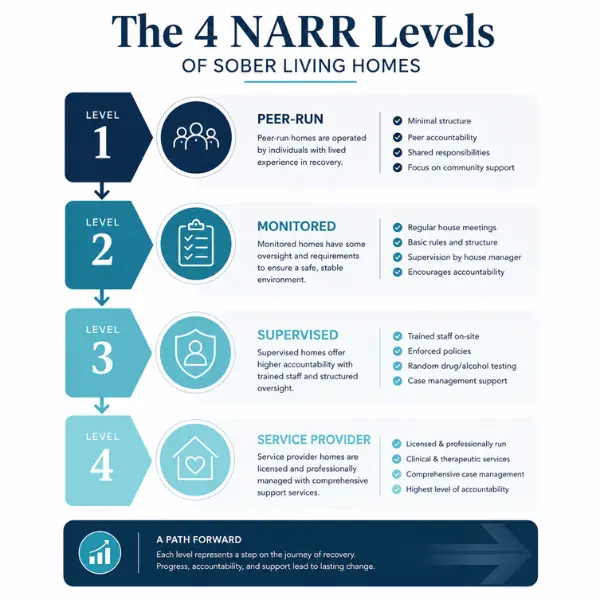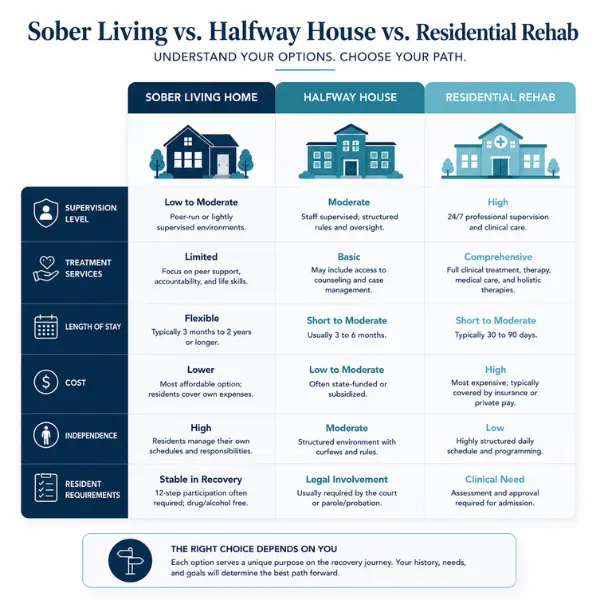

Levels of care in addiction recovery describe how treatment intensity steps down from round-the-clock medical supervision to independent sober living, matching support to each person’s stage of recovery. Understanding these levels of care helps people leaving treatment, their families, and the counselors guiding them choose the right next step rather than guessing at it, and it shows exactly where a sober living home fits within the larger continuum of care.
This guide explains what the levels of care in addiction recovery are, how the ASAM continuum of care organizes them, what the inpatient levels (detox and residential) involve, what the outpatient levels (PHP, IOP, and standard outpatient) involve, where sober living fits, how inpatient treatment differs from sober living, how people transition between levels of care, and which level of care is likely right for you.
What Are the Levels of Care in Addiction Recovery?
The levels of care in addiction recovery are the graduated stages of treatment intensity that a person moves through during recovery, ranging from medically managed inpatient care at the most intensive end to sober living and independent recovery at the least intensive end. These levels of care exist so that treatment matches the actual needs of the individual, providing more structure when stability is fragile and more freedom as recovery strengthens.
In practical terms, the levels of care fall into a recognizable order that most people move through in sequence:
- Medical detox Removes substances from the body under 24-hour medical supervision and manages withdrawal safely.
- Inpatient or residential treatment Provides 24-hour structured care and intensive therapy while the person lives at the facility.
- Partial hospitalization (PHP) Delivers full-day clinical treatment while the person lives at home or in housing.
- Intensive outpatient (IOP) Delivers several hours of therapy a week while the person resumes work, school, or family life.
- Sober living Provides substance-free, peer-supported housing that bridges treatment and full independence.
- Independent living The goal, where the person sustains recovery without a structured program.
Each level of care carries its own intensity, supervision, and duration, and the right starting point depends on factors like withdrawal risk, mental health, and the stability of a person’s home environment. The framework that standardizes these levels of care, used by treatment providers across the United States, is the ASAM continuum of care. This pathway picks up where what comes after rehab leaves off, mapping every stage rather than just the move out of treatment.
What Is the ASAM Continuum of Care?
The ASAM continuum of care is the standardized framework that defines the levels of care in addiction recovery, developed by the American Society of Addiction Medicine to match each person to the appropriate intensity of treatment. ASAM describes levels of care on a scale, from early intervention and basic outpatient through residential and medically managed inpatient care, based on dimensions such as withdrawal risk, biomedical conditions, mental health needs, and the stability of the person’s home environment.
The ASAM Criteria organize treatment into four numbered levels of care, plus recovery residences for ongoing support. Level 1 is outpatient, the least intensive. Level 2 is intensive outpatient and high-intensity outpatient. Level 3 is residential treatment, delivered with low-intensity, high-intensity, or medically managed sub-levels. Level 4 is medically managed inpatient, the most intensive. Recovery residences, which include sober living homes, sit alongside the outpatient levels as a housing layer that supports the clinical work, according to the ASAM Criteria.
A core principle of the continuum of care is that people move between levels as their needs change. Moving from a more intensive level to a less intensive one is called “stepping down,” and moving the other direction is called “stepping up.” The Substance Abuse and Mental Health Services Administration, part of the U.S. Department of Health and Human Services, describes this as a continuum that ranges from early support to intensive treatment and long-term recovery services. Research summarized by the National Institute on Drug Abuse treats substance use disorder as a chronic condition that responds best to the right intensity of care matched to the individual over time, which is exactly what the levels of care are designed to deliver.
The levels at the higher-intensity end of this continuum are the inpatient levels of care.
What Are the Inpatient Levels of Care (Detox and Residential)?
The inpatient levels of care are the most intensive stages in the continuum, providing 24-hour supervision in a live-in facility for people who need medical stabilization or a structured environment away from daily triggers. These levels of care include medically managed detox and residential treatment, and they correspond to ASAM Levels 3 and 4.
Medical detox is usually the first inpatient level of care. It eases a person through withdrawal from alcohol or other drugs while licensed medical staff manage symptoms and monitor the person around the clock. Detox can last anywhere from a few days to about a week, depending on the substance, and national guidance from the National Institute on Drug Abuse and the National Institutes of Health is clear that withdrawal from alcohol, benzodiazepines, and certain opioids can be dangerous without medical care. Detox stabilizes the body but is rarely a stand-alone solution, so it typically transitions directly into the next level of care.
Residential treatment is the inpatient level of care focused on stabilizing a person’s life rather than just the body. Residents live at the program full-time, usually for 30 to 90 days, and spend their days in individual therapy, group therapy, family sessions, and education on relapse prevention. ASAM divides residential care into clinically managed low-intensity care (Level 3.1, at least 9 hours of clinical services per week), clinically managed high-intensity care (Level 3.5), and medically managed residential care (Level 3.7, with 24-hour nursing and physician oversight). Residential treatment may be the right level of care when a person’s home environment pulls them back into use or when previous outpatient treatment was not enough.
Once a person stabilizes in an inpatient level of care, the continuum steps them down into the outpatient levels of care.
What Are the Outpatient Levels of Care (PHP, IOP, and Outpatient)?
The outpatient levels of care let a person receive structured treatment while living at home or in recovery housing, stepping down the intensity as stability grows. These levels of care include partial hospitalization, intensive outpatient, and standard outpatient, and they correspond to ASAM Levels 1 and 2.
Partial hospitalization, or PHP, is the most intensive outpatient level of care. It typically involves about 6 hours of treatment a day, 5 days a week, combining the support of full-day clinical care with the freedom of living outside the facility. PHP suits people who have completed detox or residential treatment but still need substantial daily structure before stepping down further.
Intensive outpatient, or IOP, is the level of care that most often pairs with sober living. IOP typically involves around 3 hours of treatment a day, several days a week, for a total of roughly 9 to 20 hours of therapy each week. This intensity gives a person a strong recovery framework while leaving room to work, attend school, or care for family. Because IOP assumes the person has a safe place to live, it works especially well alongside a sober living home, where the housing provides the structure and accountability that an outpatient schedule alone cannot.
Standard outpatient is the least intensive level of care, an umbrella term for scheduled therapy sessions that a person attends as needed, often once or twice a week. It is typically the final clinical level of care before a person relies primarily on community support and sober housing. Where a person lives during these outpatient levels matters as much as the clinical hours, which is where sober living enters the continuum of care.